Coding Machines Explained: How Product Coding and Marking Systems Work
Coding machines are industrial devices used to place identification or traceability information on products, packages, containers, labels, and other materials. The information may include batch numbers, manufacturing dates, expiry dates, serial numbers, barcodes, QR codes, or other product identifiers.
In manufacturing environments, coding machines help connect physical products with production and distribution records.
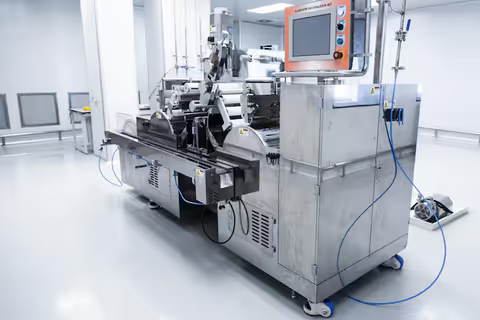
Modern industrial coding machines range from compact printers to automated systems integrated directly into production lines. Depending on the application, they can print using ink, transfer markings onto surfaces, or create permanent marks with a laser.
The broader category of industrial coding and marking machines exists because manufacturers need consistent ways to identify products during production, storage, transportation, and distribution. Manual marking can be difficult when production volumes are high or when information changes from one batch to another.
How Coding and Marking Work
A coding machine receives information from an operator, production database, programmable logic controller, or manufacturing execution system. The machine then converts that information into a visible or machine-readable mark.
A typical process involves three stages: data preparation, marking, and verification. Data preparation determines what information should appear, marking places that information on the product, and verification can check whether the printed or engraved code corresponds with the expected data.
Different technologies are suitable for different materials and production conditions. Paper, cardboard, plastic, glass, metal, and flexible packaging can require different marking methods.
Common Types of Coding Machines
Product coding machines can be grouped according to their marking technology and intended application.
| Machine type | Typical marking method | Common applications |
|---|---|---|
| Inkjet coder | Liquid ink droplets | Bottles, cartons, cables, packaging |
| Thermal inkjet printer | Controlled ink ejection | Cartons, labels, coated surfaces |
| Thermal transfer printer | Heated ribbon transfers ink | Flexible packaging and labels |
| Laser coding machine | Laser creates a surface mark | Metal, glass, plastic and packaging |
| Print-and-apply system | Prints and applies labels | Logistics and product identification |
| Automated coding system | Integrated marking process | High-volume production lines |
The appropriate technology depends on the material, required mark, production environment, line speed, and information being encoded.
Importance
Product Identification and Traceability
Coding provides information that can help identify where and when a product was manufactured. A batch number, for example, can connect a packaged item with a particular production run.
Traceability can be important in industries such as food, pharmaceuticals, electronics, automotive components, chemicals, and consumer goods. If a production issue is identified, recorded codes can help organizations determine which products or batches may be associated with the issue.
Supporting Automated Production
Automatic coding machines can receive production information electronically and mark products as they move along a production line. This reduces the need for operators to manually enter changing information for every item.
Integration can involve:
- Conveyors
- Sensors
- Programmable logic controllers
- Barcode scanners
- Cameras
- Manufacturing databases
- Enterprise production software
This allows coding to become part of a broader production workflow rather than functioning as a separate manual activity.
Reducing Identification Errors
Incorrect or missing product information can create difficulties during inventory handling, distribution, and traceability. Automated coding can provide a consistent method for applying predefined information.
However, automation does not eliminate the need for quality checks. Incorrect source data, unsuitable print settings, poor surface conditions, or equipment alignment can still result in incorrect markings.
Supporting Different Industries
Coding machines are used across many manufacturing sectors. Food and beverage production may require date and batch information, while electronics production can use serial numbers and component identifiers.
Other applications include:
- Packaging production
- Automotive components
- Building materials
- Consumer products
- Electrical and electronic products
- Industrial components
- Cosmetics and personal-care packaging
- Logistics and warehousing
The information printed or marked varies according to the industry's requirements and the product's traceability needs.
Recent Updates
Greater Digital Integration
Recent developments in industrial coding have increasingly focused on connectivity. Coding equipment can now be integrated with production databases and industrial control systems, allowing information to be transferred electronically rather than entered repeatedly.
This approach can help coordinate product information across multiple stages of production. It also creates opportunities for centralized monitoring of coding equipment and production records.
Growth of Laser Marking
Laser coding machines are increasingly used where manufacturers require markings that do not depend on conventional liquid ink. A laser can interact with a material's surface to create a permanent or semi-permanent visual mark, depending on the material and laser configuration.
Laser systems can be applied to materials such as metals, glass, selected plastics, and coated surfaces. Their suitability depends on factors such as wavelength, material properties, marking speed, and required contrast.
Smart Industrial Coding Systems
Smart industrial coding systems increasingly incorporate sensors, network connectivity, automated configuration, and production data exchange. Some systems can monitor operating conditions and provide information about equipment status.
Machine vision can also be combined with coding equipment. A camera may inspect whether a code is present, positioned correctly, or visually readable after marking.
Variable Data Printing
Variable data has become increasingly important in modern manufacturing. Instead of printing identical information on every product, an automated system can generate unique information for individual products, batches, or production orders.
Examples include:
- Sequential serial numbers
- Dynamic QR codes
- Batch identifiers
- Production dates
- Product variants
- Tracking information
This requires accurate communication between the coding machine and the source system.
Data Security and Connectivity
As coding equipment becomes more connected, cybersecurity has become another consideration. Networked machines can exchange production information with other systems, so access control, software updates, network segmentation, and data management can become part of an industrial coding architecture.
Laws or Policies
Product Information Requirements in India
In India, coding and marking requirements can depend on the type of product and the information that must appear on its packaging. The Legal Metrology Act, 2009 and the Legal Metrology (Packaged Commodities) Rules, 2011 establish requirements for declarations on specified packaged goods.
Depending on the product category, packaged goods may need information such as manufacturer or packer details, quantity, and other prescribed declarations. The exact requirements vary by product and packaging arrangement.
Coding equipment itself does not determine whether a declaration is legally sufficient. The organization responsible for the product must ensure that the information placed on packaging complies with the rules applicable to that product.
Food and Beverage Packaging
Food businesses in India are also subject to requirements administered under the Food Safety and Standards Act, 2006 and related regulations. Packaging and labelling requirements can include information relating to product identity, dates, batch or lot information, and other declarations depending on the product.
A coding machine can be used to apply variable information, but the required information and format are determined by applicable regulations rather than by the machine.
Standards and Industrial Safety
Industrial coding equipment may also need to be installed and operated according to applicable electrical, machinery, workplace, and safety requirements. Laser equipment requires particular attention to optical safety because direct or reflected laser radiation can present hazards.
Organizations should identify the regulations and technical standards applicable to their particular industry, equipment configuration, and workplace. Requirements can differ according to the product and operating environment.
Tools and Resources
Coding Software
Coding machines commonly use dedicated software or integrated controllers to create and manage print layouts. Such software may support text, numbers, barcodes, QR codes, logos, and variable production information.
Useful functions can include template management, user permissions, data import, code generation, and production-record tracking.
Barcode and QR Code Resources
Barcode standards and technical documentation can help organizations understand how machine-readable identifiers are structured. GS1 provides widely used standards for product identification and barcode systems.
QR code specifications and barcode verification tools can also be relevant when coding systems produce machine-readable information.
Machine Vision Systems
Machine vision equipment can be positioned after a coding machine to inspect printed information. A camera can examine aspects such as code presence, position, readability, and selected character characteristics.
A vision system does not necessarily replace the coding machine's own controls. Instead, it can function as an additional inspection stage.
Technical Documentation
Resources commonly used when planning or operating coding equipment include:
- Machine operating manuals
- Ink or marking-material specifications
- Laser safety documentation
- Barcode standards
- Packaging specifications
- Production line drawings
- Communication protocol documentation
- Preventive inspection schedules
Documentation from coding machine manufacturers can explain marking limitations, supported materials, environmental conditions, and integration interfaces.
FAQs
What are coding machines used for?
Coding machines apply information such as batch numbers, manufacturing dates, expiry information, serial numbers, barcodes, and QR codes to products or packaging. They are widely used in manufacturing and packaging environments.
How do industrial coding machines work?
Industrial coding machines receive information from an operator, controller, database, or production system and apply that information to a product. The marking method can involve ink, thermal transfer, labels, or laser technology.
What are laser coding machines used for?
Laser coding machines create marks by directing controlled laser energy toward a material surface. They can be used on selected metals, plastics, glass, coatings, and other materials where the laser and substrate are compatible.
What factors should be considered when selecting automatic coding machines?
Important factors include the product material, marking surface, production speed, required code type, available installation space, environmental conditions, integration requirements, and applicable labelling rules. The required information should also be clearly defined before configuring the machine.
How are smart industrial coding systems connected to production lines?
Smart industrial coding systems can communicate with programmable logic controllers, databases, manufacturing software, scanners, and machine vision equipment. This allows production information to be transferred automatically and can support code verification and traceability.
Conclusion
Coding machines provide automated methods for applying identification and traceability information to products and packaging. Industrial coding and marking machines include inkjet, thermal transfer, label-based, and laser technologies, each suited to different materials and applications. Recent developments have increased connectivity, variable-data capabilities, machine vision integration, and digital production management. In India, applicable packaging, labelling, measurement, food-safety, and workplace requirements depend on the product and operating environment.

Related Post...
Automatic Labeling & Coding Machines: An Overview of Systems, Controls and Processes
Updated: September 26, 2026
Read More
Plastic Extrusion Machines: Learn About Types, Functions and Industrial Uses
Updated: September 17, 2026
Read More
Fertilizer Granulation Machines: A Guide to Operation, Materials and Production
Updated: September 26, 2026
Read More