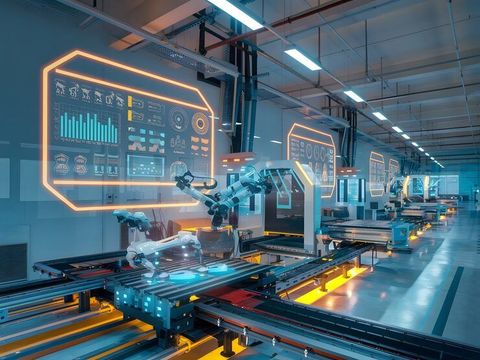
AI Predictive Maintenance Insights: Real-Time Monitoring, IoT Sensors, and Maintenance Planning
AI predictive maintenance uses IoT sensor data, real-time monitoring, and machine learning to detect early signs of equipment failure, estimate remaining useful life, and schedule maintenance before costly downtime occurs.
Instead of waiting for a breakdown or servicing assets on a fixed calendar, maintenance teams can act when actual equipment condition indicates it is necessary.
What Is AI Predictive Maintenance?
Predictive maintenance is a proactive maintenance strategy that continuously evaluates the health of machines, vehicles, HVAC systems, production lines, and other critical assets. It combines live sensor readings, historical maintenance records, operating conditions, and AI models to forecast faults or performance decline.
Traditional maintenance approaches differ in timing and cost:
| Approach | When Work Happens | Main Limitation |
|---|---|---|
| Reactive maintenance | After a failure occurs | Unplanned downtime and higher repair costs |
| Preventive maintenance | On a fixed schedule | May replace parts too early or miss unexpected faults |
| Condition-based maintenance | When a threshold is crossed | Often relies on simple rules and limited context |
| AI predictive maintenance | Before failure, based on predicted risk | Requires quality data, sensors, and model governance |
AI improves condition-based monitoring by learning each asset’s normal operating pattern and identifying subtle deviations that manual inspections or basic alarms may miss.
How Real-Time Monitoring Works
Real-time monitoring means equipment data is captured, transmitted, analyzed, and acted upon with minimal delay. IoT sensors measure parameters such as vibration, temperature, pressure, acoustics, power consumption, run-time hours, humidity, and fluid condition.
A typical real-time predictive maintenance workflow includes:
Sense: IoT sensors collect machine and environmental data.
Transmit: Gateways or industrial networks send data to an edge device, cloud platform, or maintenance system.
Analyze: AI models compare live readings with baselines, historical patterns, and known failure signatures.
Detect: The system identifies anomalies, degradation trends, or likely failure modes.
Act: Alerts, work orders, spare-part requests, and inspection tasks are generated automatically.
Edge computing is especially useful when low latency, network reliability, or data privacy is important. Local edge devices can process sensor data near the equipment and continue storing information during connectivity interruptions.
Role of IoT Sensors
IoT sensors are the foundation of predictive maintenance because they provide continuous, objective evidence of asset condition. The right sensor must match the likely failure mode and be installed at the correct measurement point.
Common sensor types include:
Vibration sensors: Detect bearing wear, imbalance, misalignment, and looseness in rotating equipment.
Temperature sensors: Identify overheating motors, friction, electrical faults, and cooling problems.
Acoustic or ultrasonic sensors: Capture unusual noise, leaks, arcing, and early mechanical defects.
Pressure and flow sensors: Monitor pumps, compressors, hydraulic systems, and pipelines.
Power and current sensors: Reveal motor stress, efficiency loss, and electrical anomalies.
Oil and fluid-quality sensors: Detect contamination, moisture, viscosity changes, and lubrication degradation.
Sensor data becomes more valuable when combined with maintenance history, production context, operating load, and asset specifications. This enables AI to distinguish a harmless operating variation from a genuine warning sign.
How AI Detects Failures
AI models generally perform two related tasks: anomaly detection and failure prediction.
Anomaly detection establishes a baseline of normal behavior using historical sensor data. Machine learning can flag unusual patterns when vibration, temperature, power draw, or acoustic readings drift outside the learned normal range.
Failure prediction uses supervised learning, deep learning, and time-series models to estimate the probability of failure or a component’s remaining useful life. For example, a model may forecast that a conveyor bearing has approximately 120 operating hours before it is likely to fail, allowing the team to replace it during planned downtime.
Useful AI techniques include:
Classification models: Predict whether an asset is healthy, degraded, or likely to fail.
Regression models: Estimate remaining useful life or time to failure.
Time-series forecasting: Project future sensor values and degradation trends.
Anomaly detection: Identify unusual behavior without requiring every failure to be labeled.
Computer vision: Inspect visual defects such as corrosion, cracks, leaks, or wear.
Maintenance Planning Benefits
Predictive maintenance turns alerts into a practical maintenance plan. When an AI system detects a developing issue, it can trigger a work order, assign a technician, check spare-part availability, and schedule the repair during a low-production window.
Key benefits include:
Less unplanned downtime: Early fault detection allows repairs to be scheduled before operations are disrupted.
Lower maintenance costs: Timely intervention reduces emergency repairs, overtime, and secondary damage.
Longer asset life: Proper lubrication, calibration, and component replacement extend equipment lifespan.
Better spare-parts management: Forecasted failures support just-in-time inventory planning.
Improved technician productivity: Teams focus on high-risk assets rather than routine inspections.
Safer operations: Detecting overheating, leaks, vibration, or electrical anomalies early reduces safety risks.
Implementation Roadmap
A successful program starts small, focuses on critical assets, and expands only after the model proves reliable in real operating conditions.
Select critical assets: Prioritize equipment where downtime, safety risk, or repair cost is highest.
Assess data readiness: Review existing sensors, historical work orders, failure records, operating logs, and system integrations.
Install appropriate sensors: Match sensors to known failure modes and configure sampling rates based on machine speed and operating conditions.
Build the data pipeline: Connect sensors through gateways to a data platform, clean noisy readings, normalize values, and validate signal quality.
Train AI models: Use historical failures and time-series data to build anomaly-detection or remaining-useful-life models.
Deploy and monitor: Run models in the cloud or at the edge, and test them in shadow mode before relying on them for maintenance decisions.
Integrate with CMMS or EAM systems: Convert alerts into prioritized work orders, inspections, and spare-part requests.
Improve continuously: Retrain models as new failure data arrives and refine alert thresholds to reduce false positives.
Common Challenges and Solutions
| Challenge | Practical Solution |
|---|---|
| Legacy equipment lacks sensors | Add external retrofit sensors rather than replacing machinery |
| Poor or incomplete data | Standardize data collection, validate sensor calibration, and clean historical maintenance records |
| Data silos | Integrate sensor, CMMS, ERP, and production systems into a shared data layer |
| Unreliable connectivity | Use edge computing to buffer and process data locally |
| Skills gap | Combine maintenance engineers, data teams, and operations staff in a cross-functional pilot |
| False alarms | Tune thresholds, validate alerts with technicians, and retrain models using confirmed outcomes |
Industry Use Cases
Manufacturing: Monitor motors, pumps, compressors, CNC machines, and conveyor systems to prevent line stoppages.
Energy and utilities: Track transformers, turbines, generators, and grid equipment for thermal or vibration anomalies.
Facilities management: Use HVAC, chiller, and elevator data to plan service before tenant-impacting failures.
Transportation and fleets: Monitor engine health, brake wear, tire pressure, and fuel efficiency.
Oil and gas: Detect pipeline leaks, pump degradation, compressor issues, and unsafe pressure conditions.
Best Practices
Start with a limited pilot on high-value assets rather than attempting a plant-wide rollout.
Define the business outcome first: fewer breakdowns, lower maintenance spend, improved uptime, or better safety.
Ensure technicians can trust and act on alerts by providing clear severity, likely cause, recommended action, and asset history.
Keep humans in the loop for high-impact maintenance decisions.
Measure results using downtime hours, mean time between failures, maintenance cost per asset, false-alarm rate, and schedule compliance.
AI predictive maintenance is most effective when technology, maintenance processes, and operational decision-making work together. IoT sensors provide visibility, real-time monitoring provides speed, and AI provides foresight—together enabling maintenance teams to move from reacting to failures toward preventing them.

Related Post...

UV Curing Systems: A Guide to UV Sources, Curing Equipment, Materials, and Industrial Applications
Updated: September 03, 2026
Read More
Recycling Machines: A Comprehensive Guide to Sustainable Waste Management
Updated: October 09, 2026
Read More
AI Tools for Everyday Life: A Guide to Productivity and Smart Automation
Updated: October 29, 2026
Read More