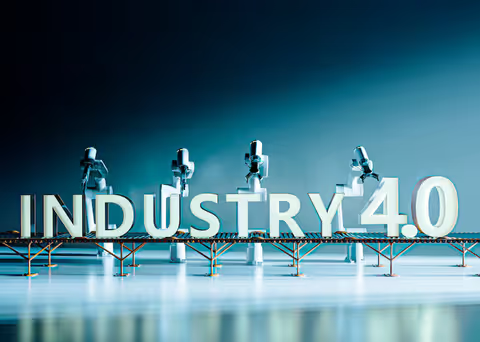
Industry 4.0 Technologies: An Informative Guide to Modern Manufacturing Basics
Industry 4.0 technologies explained in simple terms can help readers understand how modern factories and industrial organizations use connected machines, data, automation, and software.
Industry 4.0 refers to the fourth major phase of industrial development, following earlier periods associated with mechanization, mass production, and computer-based automation.
The concept became widely associated with manufacturing discussions in Germany during the early 2010s. It described a shift toward connected production systems in which machines, sensors, software, people, and physical processes can exchange information.
Earlier industrial automation often focused on individual machines or production lines. Industry 4.0 technologies extend this approach by connecting equipment and information systems so that production data can move between different parts of an organization.
The concept is not limited to factories. Similar technologies are used in logistics, energy, transportation, agriculture, healthcare equipment, and other areas where physical processes generate large amounts of data.
What Industry 4.0 Includes
Industry 4.0 is not a single technology. It is a collection of technologies that can work together, including:
- Industrial Internet of Things (IIoT)
- Artificial intelligence and machine learning
- Cloud computing
- Edge computing
- Big data analytics
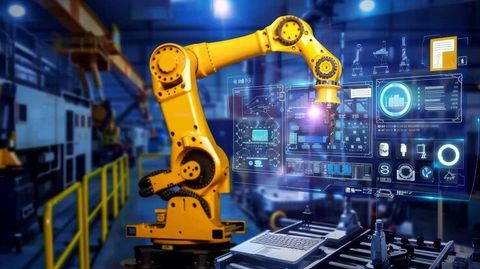
- Robotics and automated systems
- Digital twins
- Cybersecurity technologies
- Additive manufacturing
- Augmented and virtual reality
- Advanced industrial networks
The combination of these technologies allows organizations to collect information from physical processes and use it for monitoring, analysis, planning, and automation.
How Industry 4.0 Works
A simple Industry 4.0 system can begin with sensors installed on equipment. These sensors collect information such as temperature, vibration, pressure, speed, energy use, or operating status.
The information can then move through an industrial network to an edge computer, local control system, or cloud platform. Software analyzes the data and presents relevant information through dashboards or other interfaces.
Depending on the system, the resulting information may help operators identify unusual equipment behavior, monitor production conditions, or adjust selected processes.
Importance
Industry 4.0 technologies matter because modern industrial operations generate large quantities of information. Without suitable digital systems, much of this information may remain separated across machines, departments, spreadsheets, or paper records.
Connected technologies can create a more consistent flow of information between physical equipment and digital systems. This can help organizations understand production conditions and identify changes that require attention.
The topic also affects everyday life. Products such as vehicles, electronics, packaged foods, medical equipment, and household appliances can pass through manufacturing environments that use automated inspection, digital monitoring, robotics, and data analysis.
Key Industrial Challenges
Industry 4.0 addresses several common challenges in modern production environments:
- Equipment monitoring: Sensors can track operating conditions.
- Quality control: Automated inspection can identify selected physical differences.
- Production planning: Digital information can support scheduling and material coordination.
- Maintenance planning: Equipment data can help identify patterns associated with wear.
- Energy monitoring: Digital systems can track energy use across equipment or production areas.
- Traceability: Digital records can connect materials, processes, and production batches.
These applications do not remove the need for human oversight. Instead, they change how information is collected, analyzed, and used during industrial activities.
Major Industry 4.0 Technologies
| Technology | Main Function | Typical Industrial Use |
|---|---|---|
| IIoT | Connects industrial devices | Equipment monitoring |
| AI and machine learning | Analyzes patterns in data | Inspection and prediction |
| Cloud computing | Provides remote data processing | Data storage and applications |
| Edge computing | Processes information near equipment | Real-time monitoring |
| Digital twins | Represents physical systems digitally | Simulation and analysis |
| Robotics | Performs programmed physical tasks | Assembly and material movement |
| Cybersecurity | Protects digital systems | Network and data protection |
| Additive manufacturing | Builds objects layer by layer | Prototyping and component production |
Recent Updates
From 2024 through 2026, Industry 4.0 developments have increasingly focused on practical integration rather than isolated technology adoption. Artificial intelligence, industrial data platforms, edge computing, digital twins, robotics, and cybersecurity are being developed as connected parts of broader industrial systems.
One notable trend is the growing use of AI with industrial data. Machine learning models can examine large datasets from equipment, inspection systems, and production processes. Applications can include anomaly detection, visual inspection, forecasting, and process analysis.
Industrial AI
Artificial intelligence is becoming more closely connected with factory data and automation systems. Computer vision can examine images of components, while machine learning models can identify patterns in equipment measurements.
The reliability of these applications depends on factors such as data quality, sensor accuracy, model design, and appropriate human review. AI results therefore need to be interpreted within the context of the physical process.
Edge Computing
Edge computing processes selected information closer to the equipment that generates it. Instead of sending every data point to a distant computing environment, some information can be analyzed locally.
This approach can be useful where rapid responses, network availability, or data-volume management are important. Edge systems may also work alongside cloud platforms rather than replacing them.
Digital Twins
Digital twins are digital representations of physical assets, processes, or systems. They can combine information from sensors, engineering models, historical records, and simulation tools.
A digital twin may be used to study equipment behavior, examine process changes, or visualize system conditions. Its usefulness depends on the quality and frequency of the information connected to the model.
Robotics and Collaborative Automation
Industrial robotics continues to develop alongside Industry 4.0. Robots can perform repetitive movement, assembly, inspection, welding, packaging, and material-handling tasks.
Collaborative robots, often called cobots, are designed for applications where people and robotic equipment may work in closer proximity under appropriate safety arrangements. Their use requires suitable risk assessment and safeguards.
Cybersecurity
As industrial equipment becomes more connected, cybersecurity becomes an important part of Industry 4.0 planning. Connected machines can create additional digital pathways that need protection.
Current approaches emphasize network segmentation, access controls, secure device configuration, software updates, monitoring, backup procedures, and incident planning.
Laws or Policies
In India, Industry 4.0 technologies are influenced by digital technology regulations, cybersecurity requirements, data protection rules, industrial safety provisions, and government programs related to manufacturing and digital transformation.
The Digital Personal Data Protection Act, 2023 establishes a framework concerning digital personal data. Its relevance to an industrial organization depends on whether personal data is collected or processed as part of the organization's activities.
Cybersecurity and Digital Systems
Industrial organizations may also need to consider requirements and guidance related to cybersecurity and incident reporting. The Indian Computer Emergency Response Team (CERT-In) publishes directions and guidance relevant to information security and certain categories of digital systems.
Where industrial control systems connect to enterprise networks or external platforms, organizations may need to address both information technology and operational technology security.
Manufacturing and Digital Development
Government initiatives such as Digital India and programs associated with advanced manufacturing have contributed to broader digital transformation efforts. The National Programme on Artificial Intelligence and other public-sector technology initiatives also form part of India's developing digital ecosystem.
Applicable requirements vary according to the industry, organization, data involved, infrastructure, and location. Industrial safety regulations, electrical requirements, environmental rules, and sector-specific standards can also apply when digital technologies are integrated into physical production systems.
International standards such as ISO/IEC 27001, IEC 62443, and related industrial standards are often referenced when organizations develop cybersecurity and connected-system frameworks. The applicable standard depends on the system and operating environment.
Tools and Resources
A range of technical resources can help readers understand Industry 4.0 technologies and their practical applications. Standards organizations, government portals, educational platforms, engineering documentation, and technology research publications provide information about connected manufacturing and digital systems.
Useful resources include:
- Ministry of Electronics and Information Technology resources
- CERT-In cybersecurity guidance
- Bureau of Indian Standards publications
- International Organization for Standardization resources
- IEC publications related to industrial automation
- Industrial IoT reference architectures
- Digital twin modeling platforms
- Data visualization and analytics tools
- Industrial network monitoring tools
- Cybersecurity assessment frameworks
Building an Industry 4.0 System
A connected industrial system generally contains several layers. The physical layer includes machines, sensors, controllers, robots, and other equipment.
The connectivity layer transfers information between devices and software systems. The data layer stores and organizes information, while analytics applications examine patterns and produce useful information for users.
A simplified structure can look like this:
Machines and sensors → Industrial network → Edge or cloud computing → Data analytics → User interface or automated control
Security controls can operate across these layers. Human operators, engineers, managers, and maintenance personnel can interact with the system according to their responsibilities.
Common Industry 4.0 Implementation Considerations
Organizations examining digital transformation may need to consider:
- Existing equipment compatibility
- Network architecture
- Data quality
- Cybersecurity
- Workforce skills
- System interoperability
- Data storage
- Software integration
- Equipment safety
- Long-term maintenance
Older machines can sometimes be connected through additional sensors or gateways, while newer equipment may already include digital communication capabilities. The appropriate approach depends on the equipment and the intended application.
FAQs
What are Industry 4.0 technologies?
Industry 4.0 technologies are digital and automated technologies used to connect industrial equipment, collect data, analyze processes, and coordinate physical and digital systems. Examples include IIoT, AI, robotics, cloud computing, edge computing, and digital twins.
How do Industry 4.0 technologies work?
Industry 4.0 technologies typically connect machines and sensors through industrial networks. Data is collected, processed locally or remotely, analyzed by software, and presented to people or used within automated processes.
What is the role of AI in Industry 4.0?
AI in Industry 4.0 can analyze industrial data, identify patterns, support visual inspection, detect unusual conditions, and assist with process analysis. Its results depend on data quality, system design, and appropriate oversight.
Why is cybersecurity important in Industry 4.0 technologies?
Cybersecurity is important because connected industrial equipment can communicate across networks and digital platforms. Security controls help protect systems, information, devices, and operational processes from unauthorized access or disruption.
What is a digital twin in Industry 4.0?
A digital twin is a digital representation of a physical asset, process, or system. It can combine real-world data with models and simulations to support monitoring, analysis, and understanding of physical operations.
Conclusion
Industry 4.0 technologies connect physical industrial systems with digital networks, data platforms, analytics, and automation. IIoT, AI, robotics, edge computing, cloud computing, digital twins, and cybersecurity are among the major technologies associated with this industrial transition. Recent developments have emphasized integrated systems, industrial AI, connected equipment, digital twins, and stronger cybersecurity practices. In India, digital technology, data protection, cybersecurity, safety, and manufacturing policies can all influence how these technologies are implemented.

Related Post...
Industrial Process Automation Systems: An Informative Guide to Types and Functions
Updated: September 08, 2026
Read More
Clean Room Equipment Overview: Features, Standards, and Industry Applications
Updated: October 09, 2026
Read More
AI-Powered Data Labeling Tools: Explore Annotation Methods, AI Models, Automation and Data Quality
Updated: October 03, 2026
Read More