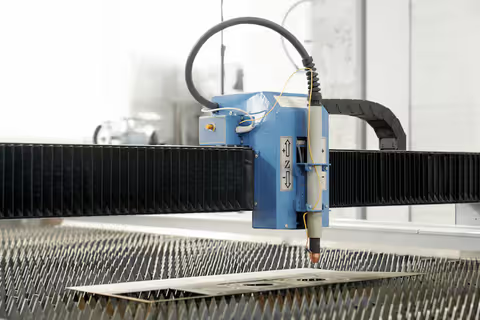
Plastic Compression & Forming Machines: Information on Materials and Operating Methods
Plastic Compression & Forming Machines are industrial systems used to shape polymer materials into specific forms through heat, pressure, molds, or combinations of these methods.
They are used to produce components such as electrical housings, automotive parts, appliance components, trays, containers, and composite products. Unlike plastic extrusion, which generally produces continuous shapes, compression and forming processes create individual parts or shaped sheets. Understanding these machines provides useful background on how heat, pressure, material behavior, and mold geometry work together in plastic manufacturing.
Context
What Are Plastic Compression & Forming Machines?
Plastic Compression & Forming Machines cover a group of equipment used to shape plastic materials through controlled forming processes. Compression molding is one of the main methods, while other forming techniques include thermoforming and related mold-based processes.
In compression molding, a measured quantity of polymer material is placed inside or near a heated mold cavity. The mold then closes under pressure, causing the material to spread throughout the cavity and take its shape.
Thermoforming follows a different principle. A plastic sheet is heated until it becomes sufficiently flexible and is then shaped over or into a mold using mechanical pressure, vacuum, or both.
These methods developed as polymer materials became increasingly important in industrial manufacturing. Their ability to create relatively complex shapes from thermoplastic, thermosetting, and composite materials has made them relevant across many industries.
How Compression Molding Works
A typical compression molding cycle consists of several controlled stages. Material preparation comes first, followed by mold preparation, material placement, mold closing, pressure application, heating or curing, mold opening, and part removal.
For thermosetting materials, heat and pressure can trigger a chemical curing reaction that permanently sets the material. Thermoplastic materials can also be shaped using heat and pressure, with the material becoming softer when heated and more rigid after cooling.
The major stages generally include:
- Preparing and measuring the molding material
- Preparing the mold surface and inserts
- Placing material into the mold cavity
- Closing the mold
- Applying controlled pressure
- Heating or maintaining the required temperature
- Cooling or curing the molded component
- Opening the mold
- Removing and inspecting the finished part
Main Types of Forming Equipment
Compression molding machines use a press mechanism to close and apply pressure to a mold. Hydraulic systems are common because they can generate controlled force across large mold areas.
Thermoforming machines heat plastic sheets and shape them against molds. Vacuum thermoforming uses pressure differences to draw a heated sheet against a mold, while pressure forming adds air pressure to improve detail in selected applications.
Other forming systems include matched-die forming, membrane forming, and specialized composite molding equipment. The appropriate machine configuration depends on material characteristics, part geometry, thickness, production volume, and dimensional requirements.
| Machine or Process | Typical Material | Common Output |
|---|---|---|
| Compression molding | Thermosets, thermoplastics, composites | Molded components |
| Vacuum thermoforming | Thermoplastic sheets | Trays, covers, containers |
| Pressure forming | Thermoplastic sheets | Detailed panels and housings |
| Matched-die forming | Sheets and composites | Structured molded parts |
| Composite compression molding | Fiber-reinforced materials | Structural components |
Materials Used
Plastic Compression & Forming Machines can process a range of polymer materials. Common thermosetting materials include phenolic compounds, epoxy-based formulations, and certain polyester systems.
Thermoplastics such as polypropylene, polyethylene, ABS, polystyrene, and PET can be used in sheet-forming applications. Fiber-reinforced materials may combine a polymer matrix with glass, carbon, or other reinforcing fibers.
Material selection depends on properties such as temperature resistance, stiffness, impact behavior, chemical resistance, dimensional stability, and intended application.
Importance
Why Plastic Compression and Forming Matter
Compression and forming processes allow manufacturers to create shaped components that would be difficult to produce through simple cutting or machining. Mold geometry can provide features such as ribs, recesses, curved surfaces, mounting areas, and openings.
These processes are used in several sectors, including:
- Automotive component manufacturing
- Electrical and electronic equipment
- Household appliances
- Packaging
- Construction products
- Industrial equipment
- Medical and laboratory products
- Composite component manufacturing
For everyday users, molded plastic components can appear in electrical enclosures, appliance housings, vehicle interiors, packaging products, and household items.
Factors That Affect Forming Quality
The quality of a molded component depends on the interaction between material, mold, temperature, pressure, and timing. A material that is too cold may not flow properly, while excessive heating can alter its properties.
Mold temperature is particularly important in processes involving thermosetting materials and composites. Pressure must also be distributed appropriately so the material reaches the required areas without creating excessive deformation.
Other factors include:
- Material moisture
- Material quantity
- Mold temperature
- Pressure level
- Heating duration
- Cooling conditions
- Mold alignment
- Part thickness
- Mold release characteristics
- Fiber orientation in composite materials
Compression Molding Compared With Other Processes
Compression molding differs from injection molding because the material is placed into the mold before the mold closes, rather than being pushed through a nozzle into a closed cavity.
Thermoforming differs because it generally begins with a plastic sheet that is heated and then shaped. Extrusion, by comparison, creates a continuous profile as material passes through a die.
| Process | Starting Material | Main Shaping Method | Typical Product Form |
|---|---|---|---|
| Compression molding | Charge or preform | Heat and pressure in mold | Individual molded part |
| Injection molding | Polymer melt | Pressure through injection unit | Individual molded part |
| Thermoforming | Plastic sheet | Heat and pressure or vacuum | Thin-walled part |
| Extrusion | Pellets or granules | Continuous die forming | Continuous profile |
Recent Updates
Automation and Digital Control
Recent development in Plastic Compression & Forming Machines has focused on automation and electronic process monitoring. Modern equipment may monitor mold temperature, hydraulic pressure, cycle time, platen position, and other operating parameters.
Programmable control systems can coordinate several stages of the molding cycle. Digital records can also help operators identify changes in process conditions and compare production cycles.
Improved Mold Monitoring
Sensors are increasingly used to observe mold temperature, pressure, displacement, and other variables. In some systems, these measurements are collected continuously and displayed through a digital control interface.
Mold monitoring is particularly useful when dimensional consistency is important. It can also help identify abnormal conditions before they affect a larger number of parts.
Energy Management
Heating systems and hydraulic equipment can account for significant energy use in plastic forming. Equipment development therefore increasingly includes improved heating control, variable-speed hydraulic systems, electrical drives, insulation, and automated shutdown functions.
Energy monitoring can help facilities understand where electricity is being consumed during different stages of production. The actual energy profile varies substantially according to machine size, material, mold design, cycle conditions, and production requirements.
Recycled and Alternative Materials
Material development is another current area of attention. Some forming applications incorporate recycled polymer content or alternative material formulations where technical requirements permit.
Material behavior can change when recycled content, fillers, fibers, or additives are introduced. For this reason, processing conditions may need to be evaluated according to the specific formulation rather than assumed to remain unchanged.
Simulation and Digital Engineering
Computer-aided engineering tools can simulate material flow, temperature distribution, pressure, deformation, and cooling behavior. Such analysis can help engineers examine mold designs before physical trials.
Digital design tools are also used to study part thickness, draft angles, reinforcing ribs, fiber orientation, and potential deformation. These methods connect mold design with process analysis and product development.
Laws or Policies
Environmental Requirements in India
Plastic forming facilities in India may be subject to environmental requirements under the Environment (Protection) Act, 1986 and related rules. Depending on the activity, pollution-control permissions and operating requirements may involve the Central Pollution Control Board and the relevant State Pollution Control Board.
The Plastic Waste Management Rules, 2016, along with subsequent amendments and related requirements, address plastic waste management. Certain plastic packaging activities can also be affected by Extended Producer Responsibility provisions.
The exact requirements depend on the type of product, materials used, facility, waste streams, and applicable state regulations.
Workplace and Equipment Safety
Plastic forming equipment involves heated surfaces, high pressure, moving platens, hydraulic systems, electrical equipment, and molds. Workplace safety requirements therefore form an important part of plant operation.
The Occupational Safety, Health and Working Conditions Code, 2020 provides a broad framework for occupational safety and working conditions, subject to its applicability and implementation framework. Facilities may also need to consider applicable fire, electrical, environmental, and machinery-related requirements.
Standards and Technical References
Bureau of Indian Standards publications may apply to particular plastic products, materials, dimensions, or testing procedures. ISO and IEC standards can also be relevant to quality management, machinery safety, electrical systems, and product testing.
The applicable standard depends on the product and process. A general machine specification does not automatically establish compliance with every requirement.
Tools and Resources
Process Measurement Equipment
Temperature sensors, pressure transducers, displacement sensors, force measurement systems, and data loggers are commonly used to monitor forming processes.
Dimensional inspection may involve calipers, coordinate measurement equipment, optical systems, gauges, and other instruments appropriate to the component.
Design and Simulation Tools
CAD software is commonly used to create mold and component geometry. Mold-flow and forming simulation tools can help examine material behavior, cooling, pressure distribution, and potential deformation.
Engineering references and polymer datasheets provide information about processing ranges, thermal characteristics, mechanical properties, and material limitations.
Regulatory and Technical Resources
Useful sources for learning about Plastic Compression & Forming Machines include:
- Bureau of Indian Standards publications
- Central Pollution Control Board guidance
- State Pollution Control Board information
- Ministry of Environment, Forest and Climate Change resources
- ISO technical standards
- IEC publications
- Polymer manufacturer technical datasheets
- Machine operation manuals
- Mold-design references
- Industrial safety documentation
These resources cover different aspects of material selection, equipment operation, product testing, environmental management, and workplace safety.
FAQs
What Are Plastic Compression & Forming Machines?
Plastic Compression & Forming Machines are equipment systems used to shape polymer materials through heat, pressure, molds, vacuum, or combinations of these methods. Compression molding and thermoforming are two widely recognized forming approaches.
How Does a Plastic Compression Molding Machine Work?
A measured quantity of material is placed in a mold cavity, after which the mold closes and pressure is applied. Heat may soften the material or initiate curing, depending on its composition. The component is then cooled or cured before mold opening.
What Materials Are Used in Plastic Compression & Forming Machines?
These machines can process thermosetting compounds, thermoplastics, and composite materials. Examples include phenolic materials, epoxy-based compounds, polypropylene, ABS, PET, and fiber-reinforced polymer systems.
What Is the Difference Between Compression Molding and Thermoforming?
Compression molding generally shapes a measured material charge within a mold under pressure. Thermoforming typically starts with a plastic sheet that is heated and shaped against a mold using vacuum, pressure, mechanical movement, or a combination of these methods.
What Industries Use Plastic Compression & Forming Machines?
Applications include automotive components, electrical equipment, appliances, packaging, construction products, industrial equipment, and composite structures. The selected process depends on the material and geometry of the required component.
Conclusion
Plastic Compression & Forming Machines use controlled heat, pressure, molds, and forming techniques to create a wide range of polymer and composite components. Compression molding and thermoforming differ in their starting materials and shaping methods, while each process has specific equipment and operating requirements. Current developments emphasize automation, digital monitoring, energy management, simulation, and material development. In India, environmental, waste-management, workplace safety, and product-specific requirements can influence the operation of plastic forming facilities.

Related Post...
Plastic Extrusion Machines: Learn About Types, Functions and Industrial Uses
Updated: September 17, 2026
Read More
Plastic Compression Molding Machine Guide for Modern Manufacturing Processes
Updated: September 07, 2026
Read More
A Beginner’s Guide to Industrial Packaging Machines and Packaging Lines
Updated: August 18, 2026
Read More