Laser-Assisted Machining: Exploring Methods, Materials and Machining Techniques
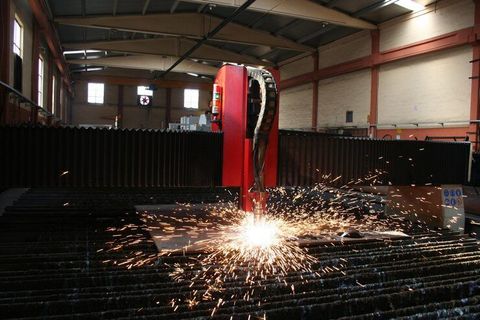
Laser-Assisted Machining is a hybrid manufacturing process that combines conventional machining with localized laser heating. A laser beam heats a selected region of a workpiece shortly before a cutting tool removes material.
The controlled heating can change the material's local mechanical behavior and make certain difficult-to-machine materials easier to process.
The technique developed from advances in laser technology, computer-controlled machining, and materials engineering. Conventional machining methods such as turning, milling, drilling, and grinding remain widely used, but some hard, brittle, or heat-resistant materials can create challenges during cutting. Laser-assisted methods were developed to address some of these challenges by adding localized thermal energy to the machining process.
How Laser-Assisted Machining Works
In a typical system, a laser is positioned so that its beam heats the workpiece immediately ahead of the cutting tool. The heated region is usually small and moves with the machining operation.
A basic process includes:
- Positioning the workpiece and cutting tool
- Selecting a suitable laser source
- Focusing the laser beam on the intended region
- Heating the material to a controlled temperature
- Moving the cutting tool through the softened or thermally affected region
- Removing material through conventional cutting action
- Monitoring the machining and thermal conditions
The laser does not normally replace the cutting tool. Instead, it acts as a localized heat source that works together with the machining operation.
Materials Used in Laser-Assisted Machining
Laser-assisted machining can be investigated for materials that are difficult to process using conventional cutting alone. These may include ceramics, hardened materials, glass, nickel-based alloys, titanium alloys, composites, and other advanced engineering materials.
The response to laser heating depends on thermal conductivity, melting behavior, hardness, fracture characteristics, optical absorption, and temperature sensitivity. Therefore, laser wavelength, power, spot size, scanning speed, and machining parameters need to be considered together.
| Process Element | Function | Important Consideration |
|---|---|---|
| Laser source | Provides localized heating | Wavelength and power |
| Focusing optics | Concentrates the beam | Spot size and position |
| Cutting tool | Removes material | Tool geometry and material |
| Workpiece | Receives heat and machining action | Thermal and mechanical properties |
| Motion system | Controls relative movement | Feed rate and alignment |
| Sensors | Monitor process conditions | Temperature and position |
| Control system | Coordinates machining and laser | Timing and parameter control |
Importance
Laser-Assisted Machining matters because some engineering materials combine high hardness, brittleness, strength, or heat resistance. These characteristics can make conventional cutting difficult and may influence tool wear, surface condition, cutting forces, or material removal behavior.
Machining Difficult Materials
Ceramics are one example of materials that can be challenging to machine because of their hardness and brittleness. Localized heating can alter the material response near the cutting region and may reduce the mechanical effort required for material removal under suitable conditions.
Nickel-based alloys and titanium alloys are also used in demanding engineering environments. Their mechanical and thermal properties can create machining challenges, making them subjects of research into hybrid processing methods.
Applications in Manufacturing
Laser-assisted methods have been studied for several manufacturing operations, including turning, milling, drilling, and grinding. The exact configuration depends on the workpiece geometry and the type of material being processed.
Potential application areas include:
- Aerospace component manufacturing
- Automotive engineering
- Medical and dental components
- Ceramic component production
- Tool and die manufacturing
- Energy equipment
- Advanced composite processing
- Research and prototype manufacturing
The suitability of the process depends on material characteristics, component geometry, required surface condition, production parameters, and the available equipment.
Cutting Forces and Tool Behavior
One purpose of localized laser heating is to modify the material near the cutting zone. Under appropriate conditions, this can influence cutting forces and the interaction between the cutting tool and workpiece.
Tool behavior is affected by many variables, including temperature, cutting speed, feed rate, material hardness, tool geometry, and lubrication. Laser-assisted machining therefore requires coordinated control of both thermal and mechanical parameters.
Surface and Subsurface Effects
Laser heating can influence the surface layer of a workpiece. If thermal input is not properly controlled, excessive heating may cause unwanted changes such as oxidation, melting, microstructural alteration, or residual thermal effects.
For this reason, researchers examine not only material removal but also surface roughness, dimensional accuracy, hardness, microstructure, residual stress, and possible heat-affected regions.
Recent Updates
Recent development in Laser-Assisted Machining has focused on improved laser control, real-time monitoring, hybrid machine platforms, simulation, automation, and processing of advanced materials.
Improved Laser Control
Modern laser systems can provide more precise control over beam power, focus, shape, and movement. These capabilities allow researchers to examine different heating patterns and match thermal input to changing machining conditions.
Beam-shaping techniques can distribute laser energy in different ways. The appropriate beam profile depends on material characteristics, tool geometry, machining speed, and the desired thermal response.
Real-Time Process Monitoring
Sensors and digital measurement systems are increasingly used to observe machining conditions. Temperature sensors, infrared cameras, optical systems, force sensors, and acoustic monitoring can provide information during processing.
Combining these measurements with machine-control data can help researchers understand how thermal conditions relate to cutting forces, tool behavior, and surface characteristics.
Hybrid Manufacturing Platforms
Some modern manufacturing systems combine laser processing with computer numerical control machining in a coordinated platform. This can reduce the need to transfer a component between separate machines for different stages of processing.
Hybrid approaches may also combine laser heating with turning, milling, drilling, or grinding. The configuration depends on the material and intended manufacturing sequence.
Simulation and Digital Modeling
Computer-based modeling is increasingly used to study heat transfer, temperature distribution, cutting forces, and material behavior. Thermal and mechanical simulations can examine how laser parameters interact with machining conditions.
Digital models can also help researchers study the size and movement of heated regions. Experimental measurements remain important because material behavior can differ from simplified theoretical models.
Advanced Materials Research
Research continues to examine laser-assisted processing of ceramics, metal matrix composites, fiber-reinforced materials, superalloys, and other engineering materials. These materials can have combinations of hardness, strength, brittleness, and thermal properties that make conventional machining challenging.
Current work also examines how laser wavelength and beam characteristics influence absorption and heat distribution for different materials.
Laws or Policies
In India, Laser-Assisted Machining is influenced by requirements related to laser safety, machinery safety, electrical systems, workplace conditions, ventilation, and environmental management.
Laser Safety
Industrial laser equipment requires appropriate controls because laser radiation can cause eye or skin hazards depending on its wavelength, power, exposure duration, and operating configuration. Enclosures, interlocks, warning systems, beam containment, protective equipment, and controlled access may be relevant.
The IEC 60825 series provides an important international framework for laser-product classification and safety considerations. Specific requirements depend on the laser system and its operating environment.
Workplace Safety
Laser-assisted machining combines laser equipment with conventional machine tools. This means safety considerations can include moving machine components, cutting tools, hot surfaces, electrical systems, metal chips, coolant, fumes, and laser radiation.
India's Occupational Safety, Health and Working Conditions Code, 2020 forms part of the broader workplace safety framework. Applicable requirements depend on the facility, machinery, workforce, and implementation rules.
Environmental Considerations
Machining can generate metal particles, dust, fumes, used cutting fluids, and other process residues. Laser heating may also create vapors or fumes when material temperatures become sufficiently high.
Appropriate extraction, filtration, housekeeping, waste handling, and ventilation depend on the material and process. The Central Pollution Control Board and relevant State Pollution Control Boards are involved in India's environmental regulatory framework.
Tools and Resources
Laser-Assisted Machining requires coordinated laser, machining, measurement, and control equipment.
Laser and Machining Equipment
Common equipment can include:
- Fiber, diode, or other suitable laser sources
- Focusing lenses and optical systems
- Beam delivery equipment
- CNC machine tools
- Cutting tools and tool holders
- Motion-control systems
- Temperature sensors
- Infrared cameras
- Power measurement instruments
- Protective laser enclosures
The appropriate laser source depends on the workpiece material, absorption characteristics, required thermal input, and machining configuration.
Measurement and Inspection
After machining, several techniques can be used to evaluate the component. Surface profilometers can measure surface roughness, while optical systems can examine dimensions and surface features.
Other techniques may include:
- Coordinate measuring machines
- Infrared thermography
- Cutting-force measurement
- Optical microscopy
- Scanning electron microscopy
- X-ray diffraction
- Hardness testing
- Metallographic analysis
These methods can help identify dimensional changes, surface characteristics, microstructural effects, and thermal alterations.
Software and Technical Resources
Computer-aided manufacturing software can coordinate tool movement and machining parameters. Thermal simulation software can model laser heating and heat transfer, while data-acquisition platforms can collect sensor measurements during experiments.
Technical references from the Bureau of Indian Standards, ISO, IEC, academic institutions, and manufacturing research organizations can provide information about machinery, laser safety, testing, and process characterization.
FAQs
What is Laser-Assisted Machining?
Laser-Assisted Machining is a hybrid manufacturing process in which a laser locally heats a workpiece immediately ahead of a conventional cutting tool. The heating changes the material's local response during machining.
How does Laser-Assisted Machining work?
In Laser-Assisted Machining, a focused laser beam heats a small region of the workpiece while a cutting tool removes material. The laser and cutting tool move in a coordinated manner so that heating occurs near the cutting zone.
What materials can be processed using Laser-Assisted Machining?
Research has examined ceramics, hardened materials, titanium alloys, nickel-based alloys, composites, and other difficult-to-machine materials. The suitability depends on thermal properties, optical absorption, hardness, geometry, and process parameters.
What are the advantages of Laser-Assisted Machining?
Laser-Assisted Machining can modify the local thermal and mechanical behavior of difficult materials during cutting. Depending on the material and parameters, this may influence cutting forces, tool behavior, material removal, and surface characteristics.
What lasers are used in Laser-Assisted Machining?
Different laser sources can be used depending on the material and machining configuration. Diode and fiber lasers are among the technologies studied for industrial heating applications, while wavelength, beam quality, power, and focusing requirements influence system selection.
Conclusion
Laser-Assisted Machining combines localized laser heating with conventional material-removal processes. It is studied for materials such as ceramics, hardened alloys, composites, and other engineering materials that can present machining challenges. Current development emphasizes precise beam control, process monitoring, hybrid machine platforms, simulation, and advanced material research. Safe operation requires suitable controls for laser radiation, machine movement, heat, electrical equipment, fumes, and machining residues.

Related Post...
Plastic Compression & Forming Machines: Information on Materials and Operating Methods
Updated: September 17, 2026
Read More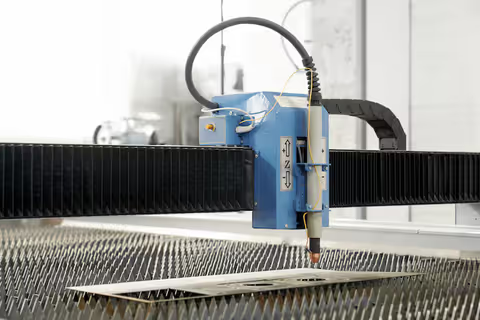
Laser-Assisted Machining: Exploring Methods, Materials and Machining Techniques
Updated: September 10, 2026
Read More
Flat Top Cranes: Inspection, Maintenance, Load Charts & Operations Facts
Updated: October 21, 2026
Read More